
Can Broccoli Sprouts Fight Cancer? What 30 Years of Research Shows
Broccoli sprouts may be one of the most powerful—and accessible—tools in cancer prevention and support.
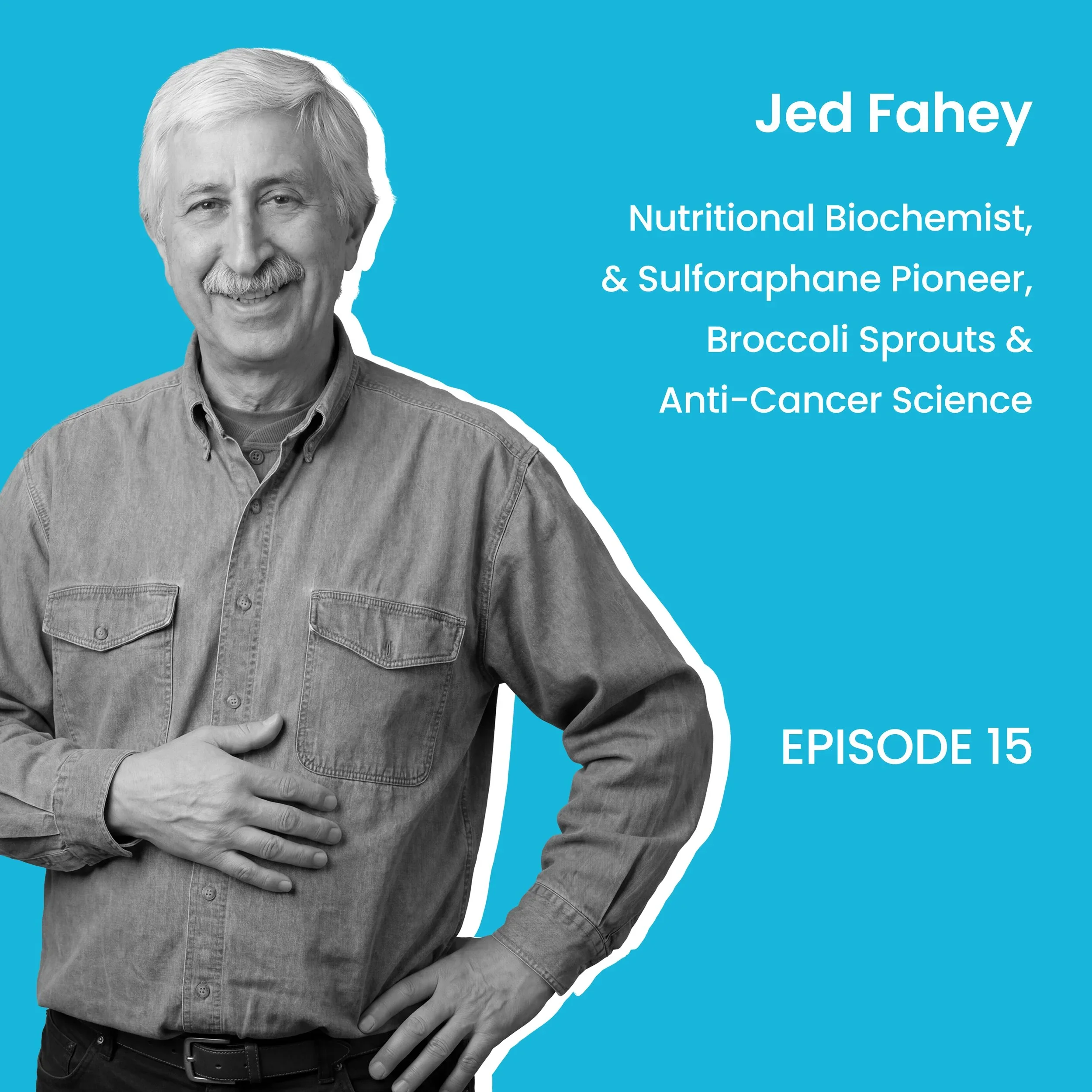
In this episode, Dr. Jed Fahey, a nutritional biochemist and one of the world’s leading experts on sulforaphane, breaks down over 30 years of research on this compound found in cruciferous vegetables.
We explore how sulforaphane works at the molecular level, including its impact on detoxification pathways like NRF2, inflammation, and cancer cell behavior. Dr. Fahey also explains the difference between broccoli and broccoli sprouts, why dosing matters, and what current research suggests about real-world use.
We also discuss:
Whether sulforaphane can enhance cancer treatment
Its potential role in targeting cancer stem cells and key pathways involved in metastasis
The difference between supplements and whole foods
Why broccoli sprouts may be one of the simplest, most actionable strategies available today
This episode is designed to help patients and caregivers translate complex science into practical, informed decisions.
Visit www.jedfahey.com to get a complete listing of Dr. Fahey’s research interests and publications.
-
00:00 Sulforaphane & Cancer: Why It Matters
02:28 Anti-Cancer Research on Sulforaphane (Studies Explained)
07:15 Dr. Jed Fahey: Johns Hopkins Sulforaphane Expert
08:05 What Is Sulforaphane? Broccoli & Broccoli Sprouts
11:21 How Sulforaphane Works: Detox, NRF2 & Cancer Pathways
15:43 Sulforaphane Dosage: Food vs Supplements
21:05 Sulforaphane Supplements: Are They Effective?
24:42 Best Dose of Sulforaphane (Research-Based Range)
26:56 Bioavailability: Myrosinase, Gut Microbiome & Absorption
29:40 Broccoli Sprouts vs Supplements: Which Is Better?
33:41 Where to Buy Broccoli Sprout Seeds (High Sulforaphane)
37:04 Cancer Costs & Why Prevention Matters
39:36 Diet & Cancer Prevention: What Studies Show
42:14 Air Pollution, Detoxification & Sulforaphane Benefits
45:39 50% Cancer Risk Reduction from Cruciferous Vegetables
51:48 Can Sulforaphane Prevent Metastasis?
54:46 Cancer Stem Cells, Dormancy & Recurrence Risk
01:03:00 NRF2 & KEAP1: Is Sulforaphane Safe in Cancer?
01:09:06 Why Cancer Nutrition Science Is Confusing
01:13:54 Should You Eat Broccoli Sprouts? (Expert Answer)
01:15:22 Sulforaphane + Cancer Treatment (Synergy Explained)
01:17:19 Food Synergy: Broccoli, Quercetin & Genistein
01:19:45 Bladder Cancer & Sulforaphane Research
01:22:58 Detoxing Benzene & Environmental Toxins
01:25:40 GLP-1 Weight Loss & Toxin Release (Why Detox Matters)
01:29:05 Diet, Doctors & Cancer Nutrition Gaps
01:31:30 Broccoli Sprouts: Practical Anti-Cancer Strategy
01:33:53 Medical Disclaimer -
1. Asif Ali M, Khan N, Kaleem N, Ahmad W, Alharethi SH, Alharbi B, Alhassan HH, Al-Enazi MM, Razis AFA, Modu B, Calina D and Sharifi-Rad J (2023) Anticancer properties of sulforaphane: current insights at the molecular level. Front. Oncol. 13:1168321. doi: 10.3389/fonc.2023.1168321
2. Sailo BL, Liu L, Chauhan S, Girisa S, Hegde M, Liang L, Alqahtani MS, Abbas M, Sethi G, Kunnumakkara AB. Harnessing Sulforaphane Potential as a Chemosensitizing Agent: A Comprehensive Review. Cancers (Basel). 2024 Jan 5;16(2):244. doi: 10.3390/cancers16020244. PMID: 38254735; PMCID: PMC10814109.
3. Liu P, Zhang B, Li Y, Yuan Q. Potential mechanisms of cancer prevention and treatment by sulforaphane, a natural small molecule compound of plant-derived. Mol Med. 2024 Jun 21;30(1):94. doi: 10.1186/s10020-024-00842-7. PMID: 38902597; PMCID: PMC11191161.
4. Kuran D, Pogorzelska A, Wiktorska K. Breast Cancer Prevention-Is there a Future for Sulforaphane and Its Analogs? Nutrients. 2020 May 27;12(6):1559. doi: 10.3390/nu12061559. PMID: 32471217; PMCID: PMC7352481. https://pubmed.ncbi.nlm.nih.gov/32471217/
5. Naujokat C, McKee DL. The "Big Five" Phytochemicals Targeting Cancer Stem Cells: Curcumin, EGCG, Sulforaphane, Resveratrol and Genistein. Curr Med Chem. 2021;28(22):4321-4342. doi: 10.2174/0929867327666200228110738. PMID: 32107991. https://www.eurekaselect.com/article/104903
6. Coutinho LL, Junior TCT, Rangel MC. Sulforaphane: An emergent anti-cancer stem cell agent. Front Oncol. 2023 Jan 23;13:1089115. doi: 10.3389/fonc.2023.1089115. PMID: 36776295; PMCID: PMC9909961. https://pubmed.ncbi.nlm.nih.gov/36776295/
7. Zhang Y, Tang L. Discovery and development of sulforaphane as a cancer chemopreventive phytochemical. Acta Pharmacol Sin. 2007 Sep;28(9):1343-54. doi: 10.1111/j.1745-7254.2007.00679.x. PMID: 17723168. https://pubmed.ncbi.nlm.nih.gov/17723168/
8. Hua Liu, Paul Talalay. Relevance of anti-inflammatory and antioxidant activities of exemestane and synergism with sulforaphane for disease prevention. PNAS. November 4, 2013 110 (47) 19065-19070. https://doi.org/10.1073/pnas.1318247110 Description text goes here
The Outperform Cancer podcast provides health information and should not be viewed as medical, nursing, or other professional healthcare advice. Listening to or engaging with the content does not create a doctor/patient relationship. Any reliance on the information from this podcast or linked materials is solely at your own discretion. This podcast's content is not meant to replace professional medical guidance, diagnosis, or care. If you have a medical issue or question, consult with a healthcare professional without delay.