
Can We Predict Which Cancer Treatment Will Work Before You Take It? | Edward Chow, PhD
How Functional Precision Medicine Could Reduce Trial-and-Error in Cancer Care
Choosing the next cancer treatment is one of the most difficult decisions patients and oncologists face.
When cancer progresses, there are often several medically reasonable options. Unfortunately, today's approach still involves a significant amount of trial and error. Every unsuccessful treatment can cost patients valuable time, expose them to unnecessary side effects, and eliminate opportunities to receive therapies that may have been more effective.
What if we could test treatments before giving them to a patient?
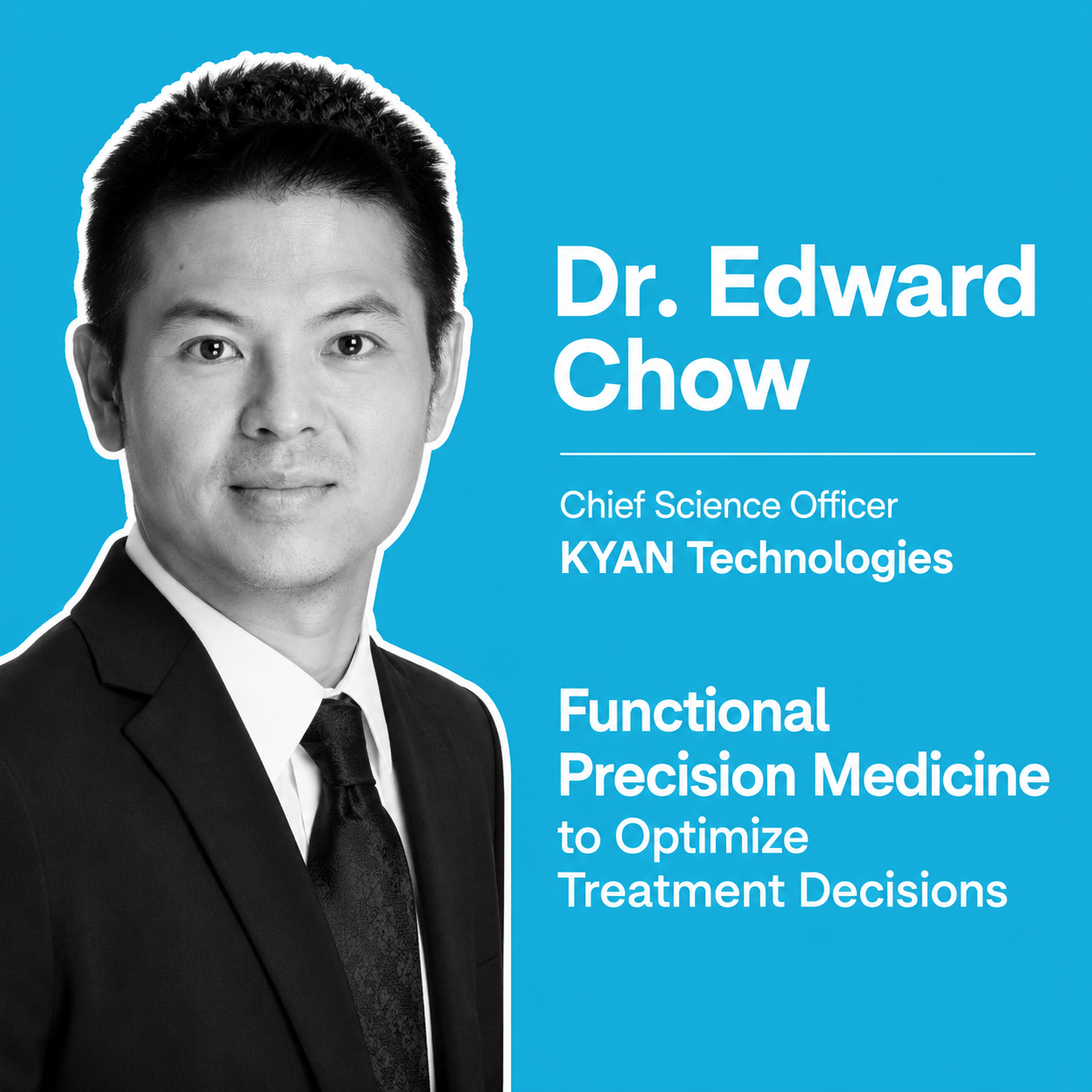
In this episode, Marybeth Gilliam interviews Edward Chow, Ph.D., Chief Scientific Officer and Scientific Co-Founder of KYAN Technologies, about one of the most exciting emerging fields in oncology: functional precision medicine.
Most cancer patients are familiar with biomarker testing, which helps identify the genetic mutations and biological drivers of a tumor. Functional precision medicine adds another layer of information by testing multiple treatments directly against a patient's living cancer cells to measure how that individual's cancer actually responds.
Rather than relying solely on population averages or educated clinical judgment, KYAN's Optm.AI™ platform combines laboratory testing with mathematics-based modeling to rank which therapies may be most effective for a specific patient. The goal isn't to replace the oncologist—it's to provide better data for one of the highest-stakes decisions a patient will ever make.
During this conversation, Marybeth and Ed discuss:
Why cancer treatment still involves considerable trial and error
How functional precision medicine differs from traditional biomarker testing
The growing body of peer-reviewed clinical evidence supporting KYAN's platform
Current strengths and limitations of functional precision medicine
Insurance coverage, costs, and how patients can access the technology today
The future of personalized cancer treatment
Perhaps the most exciting idea discussed in this episode is what functional precision medicine could eventually make possible. In addition to evaluating FDA-approved therapies, functional testing can evaluate other compounds selected for a patient's testing panel. As this field evolves, technologies like this may one day help patients and oncologists evaluate investigational therapies before enrolling in a clinical trial—bringing even more data to one of the most important decisions in cancer care.
At Outperform Cancer, we believe every important cancer decision should be as evidence-based and data-driven as possible. Functional precision medicine represents another important step toward that future.
Biography: Edward Chow, PhD
Dr. Edward Kai-Hua Chow is Chief Scientific Officer and Co-Founder of KYAN Technologies and a Fellow of the Royal Society of Chemistry. He was previously an Associate Professor in the Department of Pharmacology and Associate Director in the Cancer Science Institute of Singapore at National University of Singapore (NUS). He was also the Research Director for the Institute of Digital Medicine (WisDM). He received his B.A. in Molecular and Cellular Biology from the UC Berkeley and his Ph.D. at UCLA. Prior to joining NUS, Dr. Chow was an American Cancer Society Postdoctoral Fellow under the guidance of Prof. J. Michael Bishop (1989 Nobel Prize in Physiology or Medicine) at UCSF. His research has focused on understanding how to treat specific oncology patients or cancer subtypes as well as the oncogenic drivers that determine subtype-specific therapy. In particular, he is interested in applying engineering-based analytics towards personalised and precision drug combination design having demonstrated that drug combination design for specific disease indications as well as specific patient groups can be quickly achieved in a cost, time and sample efficient manner. He has published over 90 peer-reviewed papers with more than 11,000 citations. More importantly, his research has been commercially implemented in the clinic to provide better treatment solutions for cancer patients through KYAN’s SG MOH-licensed, CAP/CLIA clinical laboratory since 2023.
Episode Chapters
00:00 Episode Introduction
04:10 Meet Edward Chow
10:38 About KYAN Technologies
19:05 Clinical Evidence and Real Impact
33:59 From Research to Patients
42:55 Insurance and Pricing
56:26 Barriers and Future Adoption
Resources: Functional Precision Medicine
KYAN Technologies
https://kyantechnologies.com/
KYAN Publications and Peer-Reviewed Research Studies
https://kyantechnologies.com/publications/
Functional Combinatorial Precision Medicine for Predicting and Optimizing Soft-Tissue Sarcoma Treatments
https://kyantechnologies.com/functional-combinatorial-precision-medicine-for-predicting-and-optimizing-soft-tissue-sarcoma-treatments/
Rapid Therapeutic Response Prediction in Acute Myeloid Leukemia
https://kyantechnologies.com/cancer-medicine-rapid-therapeutic-response-prediction-acute-myeloid-leukemia/
Prospective Clinical Validation of a Combinatorial Functional Precision Medicine Platform in Relapsed/Refractory Non-Hodgkin Lymphoma
https://kyantechnologies.com/prospective-clinical-validation-of-a-combinatorial-functional-precision-medicine-platform-in-relapsed-refractory-non-hodgkins-lymphoma/
Additional Resources
Future of Cancer Care Today
https://futureofcancercaretoday.org/
Asthra Health (Dr. Santosh Kesari)
https://asthrahealth.com/
Palitra Bio
https://palitra.bio/
Kernis Health
https://kernis.health/
About Outperform Cancer
Outperform Cancer translates peer-reviewed cancer research into practical, evidence-based strategies that help patients become informed partners in their care. Through conversations with leading scientists, physicians, and patient advocates, we explore emerging technologies and actionable strategies that may improve outcomes and help patients make more informed decisions.
Medical Disclaimer
The information presented by Outperform Cancer is provided for educational and informational purposes only and is not intended to diagnose, treat, cure, or prevent any disease. The content shared in our podcasts, articles, videos, and website should not be considered medical advice or a substitute for professional medical care.
Cancer treatment decisions are complex and highly individualized. Patients should always discuss treatment options, diagnostic tests, medications, supplements, and lifestyle interventions with their oncology team or other qualified healthcare professionals before making changes to their care.
The discussion of specific therapies, technologies, physicians, companies, research studies, or products does not constitute an endorsement or recommendation by Outperform Cancer. Our goal is to help patients become informed partners in their care by translating peer-reviewed research into understandable, evidence-based information.
Medical knowledge continues to evolve, and new evidence may change how treatments are understood or used over time.