

Daily Aspirin
Evidence now makes it clear that aspirin’s anti‑cancer effects are real but selective: they depend on age, timing of start, duration, cancer type, and baseline risk, but for those who can benefit, the benefit is significant.
Based on established research, aspirin is most likely to benefit specific cancer patients:
Colon cancer patients especially with PIK3CA mutations or at risk adults with Lynch Syndrome
Early stage (I-III) cancer patients who want to avoid metastasis
Adults aged 40-65 who regularly take a low-dose aspirin for 5-10 years to prevent cancer and prevent recurrence of GI cancers (stomach, esophagus, liver, pancreas, small intestine)
New research (2025) explains exactly how aspirin inhibits cancer (mechanism of action)— these results should lead to more specific clinical trials determining those who will or will not derive a survival benefit.

Aspirin had a Significant Positive Effect in this Pivotal Study
🟢 Early-stage (I-III) colorectal cancer with PI3K pathway mutations (after surgery)
What happened:
Over three years, aspirin roughly cut the risk of recurrence in half, reducing recurrence by about 6 fewer patients per 100.
About 14 out of 100 patients on placebo had recurrence.
About 8 out of 100 patients on aspirin had recurrence.
Bottom line: Strong randomized evidence of benefit — but only in certain early-stage patients with specific tumor mutations.
NOTE: Every cancer patient should get biomarker testing—ask your doctor to identify your specific mutations (≈20% of colorectal cancers have PIK3CA). Read on for further biomarker information.
Study Link: ALASCCA Trial – New England Journal of Medicine (2025)
Other Positive Aspirin Studies
🟡 Large randomized controlled heart-disease prevention trial, post analysis of 17,285 participants measuring cancer metastasis
Of participants who developed an adenocarcinoma, those allocated to daily aspirin had about a 45–50% lower risk of distant metastasis compared with controls.
Daily aspirin was associated with about a 35% lower overall risk of fatal adenocarcinoma & ~50% lower risk of death among those who developed adenocarcinoma, but no reduction in deaths from other solid cancers.
This suggests aspirin may reduce metastatic spread for some cancers when taken before/early in cancer.
Rothwell, Peter M et al. 2012, The Lancet
🟡 Breast cancer observational studies specific to post-diagnostic aspirin and breast cancer specific mortality
Wu & Hu 2023 (Women & Health) 15 cohort studies, 131,636 women: 27% lower mortality and 23% lower recurrence.
Chen et al. 2024 (Diagnostics) – 20 studies, 141,251 participants: 23% lower mortality.
Baker & Kartsonaki 2023 (The Oncologist) – 24 papers, 149,860 women: 21% lower mortality
Earlier meta‑analyses (Huang et al. 2015; Liu et al. 2021) similarly report breast‑cancer‑specific death, ≈21–31% lower mortality with post‑diagnosis aspirin
🟡 Multiple cancers (observational meta-analyses)
8 trials, 25 570 participants: lowered cancer mortality by about 20%.
Importantly, reduction in cancer deaths only became apparent after about 5 years of follow‑up.
After 7.5 years the relative reduction in risk increased to 31%
Benefit did not depend on aspirin dose above 75 mg.
Important: Above are results from observational studies, not randomized trials. An observational study is research in which scientists observe what happens to people based on their real-world behaviors — without assigning treatments. Some people choose to take aspirin while others do not. Researchers then compare outcomes.
Observational studies are meaningful and hypothesis-generating, but they are less definitive for guiding clinical decisions. So while they generated results, the results are not as compelling as randomized, controlled trials.
Aspirin Did Not Help These Patients
🔴 Older adults (aged 70+) with advanced cancers
What happened:
In one large randomized trial in older adults, those assigned to aspirin had increased incidence of metastatic disease, and among stage III-IV patients, higher cancer-related mortality compared to placebo.
Bottom line: Aspirin may be harmful in some older patients.
Study Link: ASPREE Cancer Sub-analysis (JAMA)
🔴 Metastatic colorectal cancer (with liver metastases)
What happened:
Aspirin did not improve survival or delay progression in patients with stage IV colorectal cancer.
Bottom line: No proven benefit in metastatic colorectal cancer.
Study Link: ASAC Phase 3 Trial
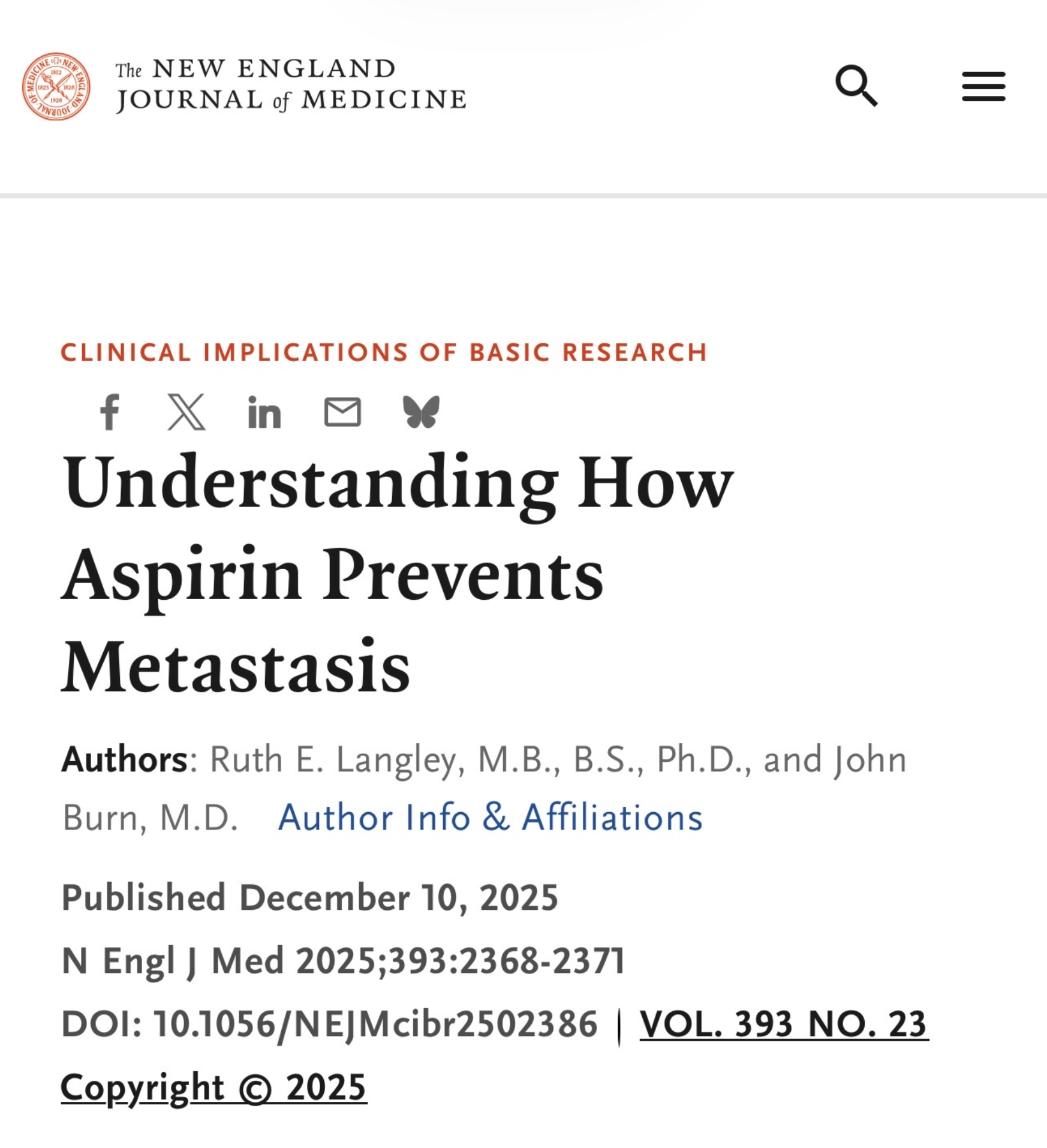
In 2025, Nature published a critical research paper titled, “Aspirin prevents metastasis by limiting platelet TXA(2) suppression of T cell immunity,” describing the mechanism of action for aspirin and how it might reduce metastasis and recurrence at a cellular level.
World renowned researchers, Ruth Langley, M.B., B.S., Ph.D, and John Burns, M.D., wrote a follow-up summary published in the New England Journal of Medicine saying:
“This finding led to the conclusion that the anti-metastatic effects of aspirin are mediated by T cells through ARHGEF1 and provided, for the first time, a clear link between the known pharmacologic effects of low-dose daily aspirin use and cancer elimination.“
Based on the strength of these two publications, it seems clear that the current body of research has not fully captured the potential of positive impact that aspirin may provide.
The Big Story Not Yet Reflected in the Research
Effective aspirin doses in trials with cancer benefit are generally low (81 mg/day), with several long-term trials monitoring use at 75-100mg/day over many years.
The clearest random controlled trial (RCT) used a dose of 160mg/day for colon cancer with PIK3 mutated patients.
Importantly, more does not seem to be better and could be worse. The “ABC” phase III trial for Her2- early stage breast cancer patients used a dose of 300mg/day; it did not improve survival or reduce recurrence. All the studies I found with successful results used low-to-mid doses over long time periods.
What dose of aspirin is used in clinical research?

Your Cancer Is as Unique as Your Fingerprint
No two fingerprints are alike. We use them to unlock our most secure devices.
Your cancer is just as unique. Every tumor carries its own set of biomarkers — genetic mutations and molecular signals that can determine which treatments may work specifically for you.
In the past, research often ignored biomarkers. A therapy might have worked extremely well for a small subgroup — but when results were averaged across everyone, the benefit disappeared.
That era is over.
Today, biomarker testing is not optional — it is foundational. If you have cancer, you should know your tumor’s genomic profile. Ask your doctor whether comprehensive genomic sequencing has been done. If it hasn’t, ask why, and push to get it done.
The most compelling aspirin trial showed benefit only in colorectal cancer patients with a specific PIK3 mutation. Without biomarker testing, that signal would have been missed. And, this may be why other research hasn’t produced more positive results.
Precision matters. Your treatment decisions should be based on your biology — not population averages. Get your tumor sequenced. Learn your biomarkers. Then build a strategy that fits your cancer — not someone else’s.
And if you need help interpreting what you find, I’m here.

Match Your Biomarkers to the Mechanism of Action(MOA)
Once you know your tumor’s biomarkers, don’t just ask whether a strategy works — ask how it works.
In 2025, researchers clarified aspirin’s mechanism of action in cancer. A study in Nature showed that platelets release TXA₂, a molecule that suppresses anti-cancer T cells through a pathway involving ARHGEF1. Aspirin blocks COX-1, reduces TXA₂, and helps “release the brakes” on the immune system’s ability to fight metastatic spread.
Later that year, a randomized trial in the New England Journal of Medicine showed that aspirin reduced recurrence — but only in early-stage colorectal cancer patients with specific PI3K pathway mutations.
That’s precision medicine.
The biology suggested who might benefit.
The biomarker-selected trial confirmed it.
This is how you should think about every anti-cancer strategy:
What pathway does it target?
Does my tumor have alterations in that pathway?
Does the mechanism make sense for my cancer?
Your strategy should be based on mechanism — matched to your biomarkers — not population averages.
Do your own research, too.
This website highlights some particularly compelling research studies but I encourage you to do your own research. Often your medical center has a library with wonderful librarians that are happy to help and with full access to all the latest information.